This product has been discontinued. Please see this similar product instead.This combination deal contains most of the parts you need to build an Arduino-controlled Zumo robot. It consists of a Zumo Shield for Arduino, a Zumo chassis kit, and a Zumo blade. You will also need a pair of micro metal gearmotors, four AA batteries, and an Arduino to complete your Zumo robot (motors, batteries, and Arduino sold separately). This product is a kit; assembly (including soldering) is required.
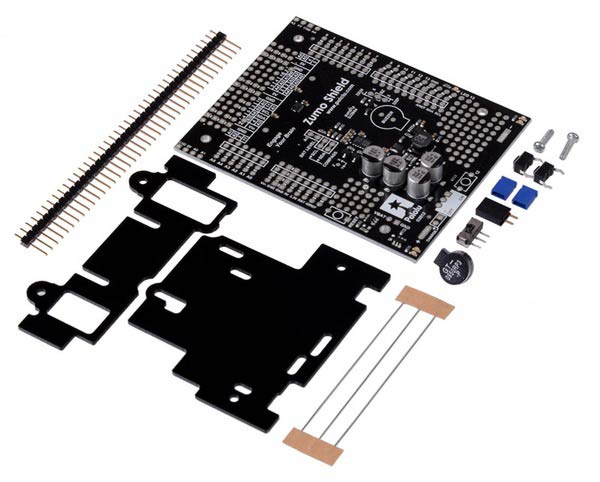
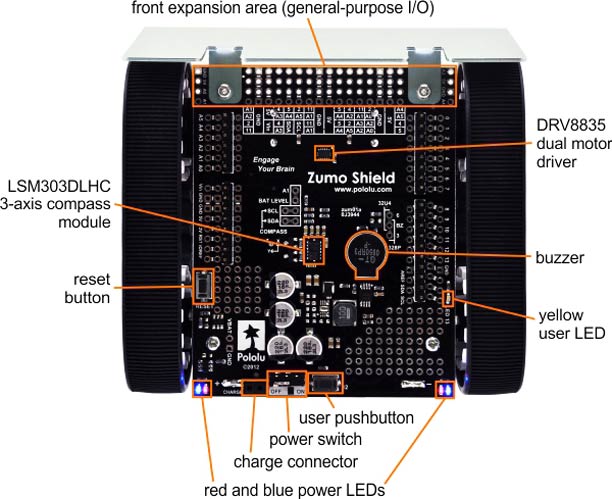
The Zumo Shield is designed specifically to be a convenient interface between a Zumo chassis and an Arduino Uno or Leonardo. The shield mounts directly to the chassis, connecting to its battery terminals and motors, and the Arduino plugs into the shield's male header pins, face down. The shield provides all the electronics necessary to power the motors and includes some additional fun components for making a more interesting robot, such as a buzzer for making sounds and a 3-axis accelerometer and compass.
With the Zumo Shield and an Arduino, the Zumo chassis becomes a low-profile, Arduino-controlled tracked robot that is less than 10 cm on each side (small enough to qualify for Mini-Sumo competitions). It works with a variety of micro metal gearmotors to allow for a customizable combination of torque and speed, and a stainless steel sumo blade is available for applications that involve pushing around other objects. Arduino libraries and sample sketches are available for quickly getting a Zumo robot up and running.
The Zumo chassis kit contains the components necessary to build a small, high-performance tracked robot platform that is compact enough to qualify for Mini Sumo competitions. Each side of the chassis has an idler sprocket that spins freely and a drive sprocket that connects to a micro metal gearmotor (not included). The main body is composed of ABS plastic and has sockets for two micro metal gearmotors and a compartment for four AA batteries (not included). The battery compartment terminals protrude through the chassis and can be accessed from the top side. A black acrylic plate is included with the chassis. This plate holds the motors in place and can be used for mounting your electronics, such as your microcontroller, motor drivers, and sensors.
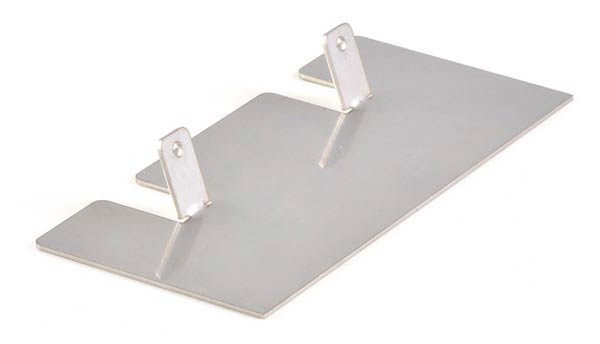
A basic sumo blade (sometimes also called a "scoop") is intended for use with the Zumo chassis. It is made of 0.036"-thick, laser-cut stainless steel, and it ships flat. The two tabs must be bent to an angle of approximately 70¡ before it can be mounted to the front of the Zumo chassis. We recommend using a pair of long-nose pliers to bend the tabs.
Warning: Do not try to bend the tabs after mounting the blade to the Zumo chassis as this could crack the chassis' acrylic mounting plate or the mounting tabs themselves.
Zumo Shield Features
- Integrated DRV8835 dual motor drivers capable of delivering enough current for two high-power (HP) micro metal gearmotors. See the Zumo chassis product page for specific motor suggestions.
- Piezo buzzer for playing simple sounds and music. The buzzer is controlled by one of the Arduino's PWM outputs, so the tones can be generated in the background without taking up a lot of processing power.
- Integrated LSM303DLHC 3-axis accelerometer and 3-axis magnetometer that can be used to detect impacts. The compass gets a lot of interference from the motors, batteries, PCB, and its surroundings, so it is not generally useful for precision navigation, but we have found that with proper calibration, it can be used for rough orientation measuring in many environments.
- Optional user pushbutton on pin 12.
- 7.5 V boost regulator for powering the Arduino from the Zumo's 4 AA batteries.
- Convenient access to Arduino I/O lines, the pin 13 user LED, and the Arduino reset line via the shield.
- General-purpose prototyping areas and an expansion area at the front for connecting additional sensors (it is easy to add up to five QTR sensors for edge detection or line following).
- Compatible with the Arduino Uno R3 and Arduino Leonardo, and can also be used with older Arduinos that have the same form factor, like the Duemilanove.
- Arduino libraries and sample code make getting started easy.
- Detailed user's guide with assembly instructions.
Specs
Blade Dimensions: 44 x 98 x 0.91mm
Blade Weight: 1.02 oz
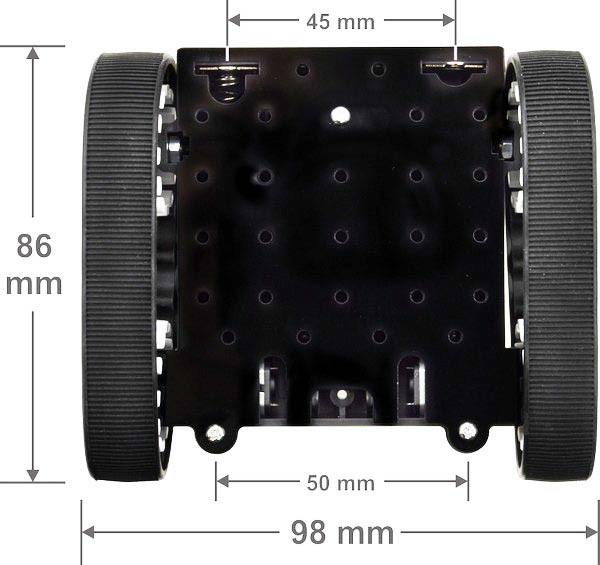
Chassis Dimensions: 98 x 86 x 39
Chassis Weight: 3.0 oz, without motors or batteries
Needed to Complete
Two micro metal gearmotor
Four "AA" Batteries
An Arduino
 $42.95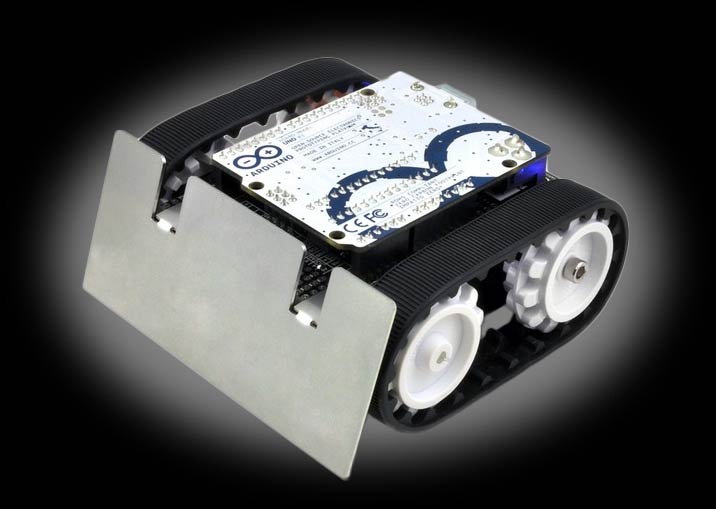


 Zumo Shield User's Guide