| |
Pololu Dual VNH5019 Motor Driver Shield for Arduino
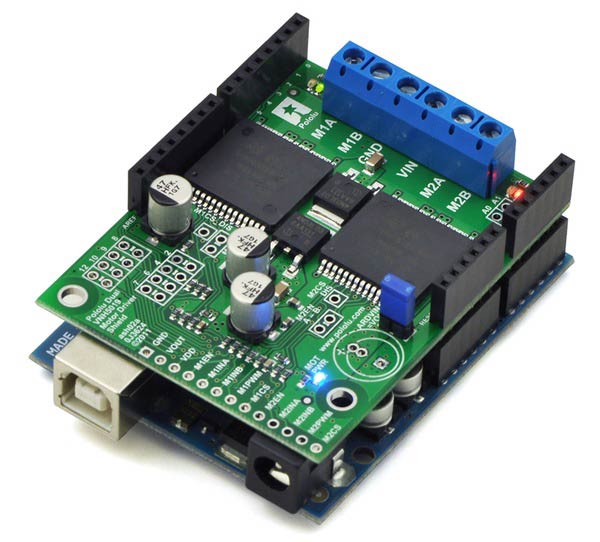
Get your Arduino moving! This shield makes it easy to control two high-power DC motors with your Arduino or Arduino-compatible board. |
 $59.95
|
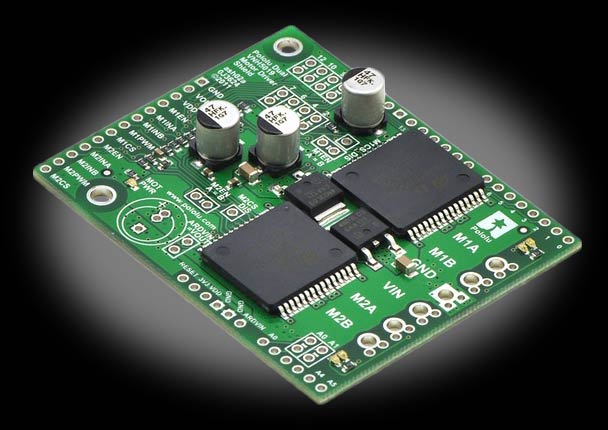
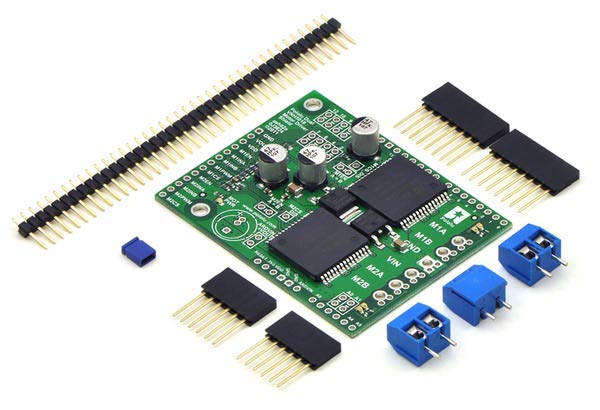
0-PL2502 Pololu Dual VNH5019 Motor Driver Shield for Arduino <p><font color="00ff66" size="2" face="Arial, Helvetica, sans-serif">This motor driver shield and its corresponding Arduino library make it easy to control two bidirectional, high-power, brushed DC motors with an Arduino or Arduino clone. The board features a pair of robust VNH5019 motor drivers from ST, which operate from 5.5 to 24V and can deliver a continuous 12A (30A peak) per channel, and incorporates most of the components of the typical application diagram on page 14 of the VNH5019 datasheet, including pull-up and protection resistors and FETs for reverse battery protection. It ships fully populated with its SMD components, including the two VNH5019 ICs, stackable Arduino headers and terminal blocks for connecting motors and motor power are included but are not soldered in (see the Included Hardware section below).</font></p>
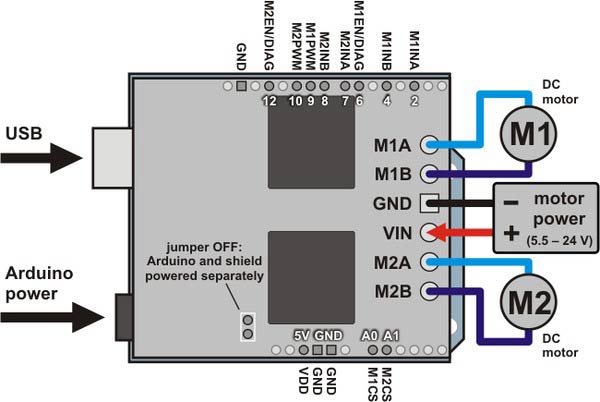
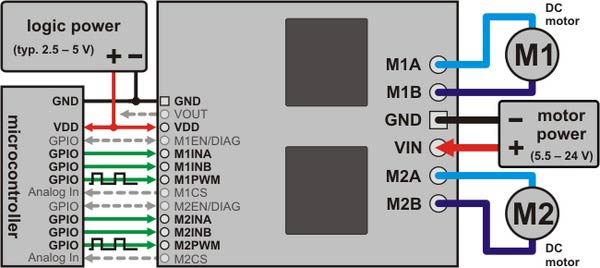
<p><font color="00ff66" size="2" face="Arial, Helvetica, sans-serif">This versatile motor driver is intended for a wide range of users, from beginners who just want a plug-and-play motor control solution for their Arduinos (and are okay with a little soldering) to experts who want to directly interface with ST's great motor driver ICs. The Arduino pin mappings can all be customized if the defaults are not convenient, and the VNH5019 control lines are broken out along the left side of the board for general-purpose use without an Arduino (see the connection diagram). This versatility, along with an option to power the Arduino directly from the shield, sets this board apart from similar competing motor shields. </font></p>
<font color="cccccc" size="2" face="Arial, Helvetica, sans-serif">Features</font><font color="00ff66" size="2" face="Arial, Helvetica, sans-serif"><br />
</font>
<ul>
<li><font color="00ff66" size="2" face="Arial, Helvetica, sans-serif">Wide operating voltage range: 5.5 – 24V</font></li>
<li><font color="00ff66" size="2" face="Arial, Helvetica, sans-serif">High output current: up to 12 A continuous (30 maximum) per motor<br />
</font></li>
<li><font color="00ff66" size="2" face="Arial, Helvetica, sans-serif">Motor outputs can be combined to deliver up to 24A continuous (60A maximum) to a single motor<br />
</font></li>
<li><font color="00ff66" size="2" face="Arial, Helvetica, sans-serif">Inputs compatible with both 5V and 3.3V systems (logic high threshold is 2.1V)<br />
</font></li>
<li><font color="00ff66" size="2" face="Arial, Helvetica, sans-serif">PWM operation up to 20 kHz, which is ultrasonic and allows for quieter motor operation<br />
</font></li>
<li><font color="00ff66" size="2" face="Arial, Helvetica, sans-serif">Current sense voltage output proportional to motor current (approx. 140 mV/A)<br />
</font></li>
<li><font color="00ff66" size="2" face="Arial, Helvetica, sans-serif">Motor indicator LEDs show what the outputs are doing even when no motor is connected<br />
</font></li>
<li><font color="00ff66" size="2" face="Arial, Helvetica, sans-serif">Can be used with an Arduino or Arduino clone (through shield headers) or other microcontroller boards (through 0.1" header on left side)<br />
</font></li>
<li><font color="00ff66" size="2" face="Arial, Helvetica, sans-serif">When used as a shield, the motor power supply can optionally be used to power the Arduino base as well<br />
</font></li>
<li><font color="00ff66" size="2" face="Arial, Helvetica, sans-serif">Arduino pin mappings can be customized if the default mappings are not convenient<br />
</font></li>
<li><font color="00ff66" size="2" face="Arial, Helvetica, sans-serif">Arduino library makes it easy to get started using this board as a motor driver shield<br />
</font></li>
<li><font color="00ff66" size="2" face="Arial, Helvetica, sans-serif">Detailed user’s guide<br />
</font></li>
<li><font color="00ff66" size="2" face="Arial, Helvetica, sans-serif">Reverse-voltage protection<br />
</font></li>
<li><font color="00ff66" size="2" face="Arial, Helvetica, sans-serif">Robust drivers:<br />
</font>
<ul>
<li><font color="00ff66" size="2" face="Arial, Helvetica, sans-serif">Can survive input voltages up to 41V<br />
</font></li>
<li><font color="00ff66" size="2" face="Arial, Helvetica, sans-serif">Undervoltage and overvoltage shutdown<br />
</font></li>
<li><font color="00ff66" size="2" face="Arial, Helvetica, sans-serif">High-side and low-side thermal shutdown<br />
</font></li>
<li><font color="00ff66" size="2" face="Arial, Helvetica, sans-serif">Short-to-ground and short-to-Vcc protection</font></li>
</ul>
</li>
</ul>
<p><font color="cccccc" size="2" face="Arial, Helvetica, sans-serif">Included Hardware</font><font color="00ff66" size="2" face="Arial, Helvetica, sans-serif"><br />
This motor driver board ships with all of the surface-mount parts populated. However, soldering is required for assembly of the included through-hole parts. The following through-hole parts are included:</font></p>
<ul>
<li><font color="00ff66" size="2" face="Arial, Helvetica, sans-serif">Two extended/stackable 1x8 female headers (for Arduino shields)</font></li>
<li><font color="00ff66" size="2" face="Arial, Helvetica, sans-serif">Two extended/stackable 1x6 female headers (for Arduino shields)</font></li>
<li><font color="00ff66" size="2" face="Arial, Helvetica, sans-serif">Three 2-pin 5mm terminal blocks (for board power and motor outputs)</font></li>
<li><font color="00ff66" size="2" face="Arial, Helvetica, sans-serif">40-pin 0.1" straight breakaway male header (may ship in several pieces, such as two 20-pin strips)</font></li>
<li><font color="00ff66" size="2" face="Arial, Helvetica, sans-serif">A 0.1" shorting block (for optionally supplying shield power to Arduino) is also included </font></li>
</ul>
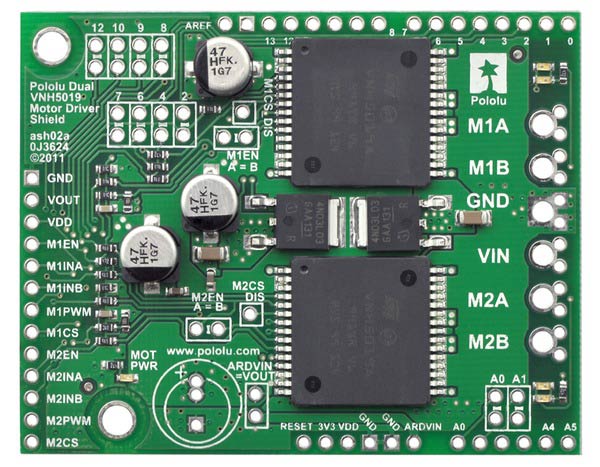
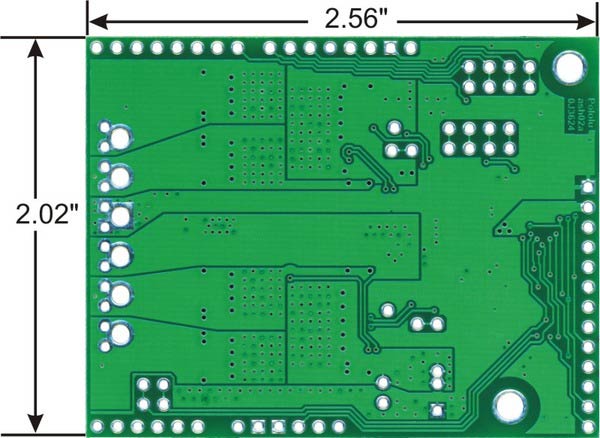
<p><font color="00ff66" size="2" face="Arial, Helvetica, sans-serif">You can solder the terminal blocks to the six large through-holes to make your motor and motor power connections, or you can break off a 12x1 section of the 0.1" header strip and solder it into the smaller through-holes that border these larger holes. Note, however, that the terminal blocks are only rated for 16A, and each header pin pair is only rated for a combined 6A, so for higher-power applications, thick wires should be soldered directly to the board.</font></p>
<p><font color="00ff66" size="2" face="Arial, Helvetica, sans-serif">When not using this board as an Arduino shield, you can solder the 0.1" headers to the logic connections along the left side of the board to enable use with custom cables or solderless breadboards, or you can solder wires directly to the board for more compact installations. Note that motor and motor power connections should not be made through a breadboard.</font></p>
<p><font color="00ff66" size="2" face="Arial, Helvetica, sans-serif">The motor driver includes three 47 uF electrolytic power capacitors, and there is room to add additional capacitors (e.g. to compensate for long power wires or increase stability of the power supply). Additional power capacitors are usually not necessary, and no additional capacitors are included with this motor driver.</font></p>
<p><font color="00ff66" size="2" face="Arial, Helvetica, sans-serif">The two mounting holes are intended for use with #4 screws (not included). They have a horizontal separation of 0.30" and a vertical separation of 1.7". </font></p>
<p><font color="cccccc" size="2" face="Arial, Helvetica, sans-serif">Real-world power dissipation consideration</font><font color="00ff66" size="2" face="Arial, Helvetica, sans-serif"><br />
Each motor driver IC has a maximum continuous current rating of 30A. However, the chips by themselves will overheat at lower currents (see the table above for typical values). The actual current you can deliver will depend on how well you can keep the motor drivers cool. The shield's printed circuit board is designed to draw heat out of the motor driver chips, but performance can be improved by adding heat sinks. In our tests, we were able to deliver short durations (on the order of milliseconds) of 30A and several seconds of 20A without overheating. At 6A, the chip gets just barely noticeably warm to the touch. For high-current installations, the motor and power supply wires should also be soldered directly instead of going through the supplied terminal blocks, which are rated for up to 16A.</font></p>
<p><font color="00ff66" size="2" face="Arial, Helvetica, sans-serif">Many motor controllers or speed controllers can have peak current ratings that are substantially higher than the continuous current rating; this is not the case with these motor drivers, which have a 30A continuous rating and over-current protection that can kick in as low as 30A (50A typical). Therefore, the stall current of your motor should not be more than 30A. (Even if you expect to run at a much lower average current, the motor can still draw short bursts of high currents, such as when it is starting, if special steps are not taken.)</font></p>
<table width="100%" border="1" cellspacing="0" cellpadding="0">
<tr>
<td colspan="2"><font color="cccccc" size="2" face="Arial, Helvetica, sans-serif">Specs</font></td>
</tr>
<tr>
<td><font color="00ff66" size="2" face="Arial, Helvetica, sans-serif">Motor Driver </font></td>
<td><font color="00ff66" size="2" face="Arial, Helvetica, sans-serif">VNH5019</font></td>
</tr>
<tr>
<td><font color="00ff66" size="2" face="Arial, Helvetica, sans-serif">Motor Channels </font></td>
<td><font color="00ff66" size="2" face="Arial, Helvetica, sans-serif">2</font></td>
</tr>
<tr>
<td><font color="00ff66" size="2" face="Arial, Helvetica, sans-serif">Minimum Operating Voltage </font></td>
<td><font color="00ff66" size="2" face="Arial, Helvetica, sans-serif">5.5V</font></td>
</tr>
<tr>
<td><font color="00ff66" size="2" face="Arial, Helvetica, sans-serif">Maximum Operating Voltage </font></td>
<td><font color="00ff66" size="2" face="Arial, Helvetica, sans-serif">24V</font></td>
</tr>
<tr>
<td><font color="00ff66" size="2" face="Arial, Helvetica, sans-serif">Continuous Output Current Per Channel </font></td>
<td><font color="00ff66" size="2" face="Arial, Helvetica, sans-serif">12A</font></td>
</tr>
<tr>
<td><font color="00ff66" size="2" face="Arial, Helvetica, sans-serif">Peak Output Current Per Channel </font></td>
<td><font color="00ff66" size="2" face="Arial, Helvetica, sans-serif">30A</font></td>
</tr>
<tr>
<td><font color="00ff66" size="2" face="Arial, Helvetica, sans-serif">Current Sense </font></td>
<td><font color="00ff66" size="2" face="Arial, Helvetica, sans-serif">0.14 V/A </font></td>
</tr>
<tr>
<td><font color="00ff66" size="2" face="Arial, Helvetica, sans-serif">Maximum PWM Frequency </font></td>
<td><font color="00ff66" size="2" face="Arial, Helvetica, sans-serif">20 kHz </font></td>
</tr>
<tr>
<td><font color="00ff66" size="2" face="Arial, Helvetica, sans-serif">Size</font></td>
<td><font color="00ff66" size="2" face="Arial, Helvetica, sans-serif">2.56 x 2.02 x 0.38 in. </font></td>
</tr>
<tr>
<td><font color="00ff66" size="2" face="Arial, Helvetica, sans-serif">Weight</font></td>
<td><font color="00ff66" size="2" face="Arial, Helvetica, sans-serif">18g</font></td>
</tr>
</table>
<p><font color="ff0000" size="2" face="Arial, Helvetica, sans-serif">NOTE: While the overvoltage protection typically kicks in at 27V, it can trigger at voltages as low as 24V, so we do not recommend using this motor driver with 24V batteries, which significantly exceed 24V when fully charged. If the shield is configured to power an Arduino or Arduino clone, the supply voltage must conform to that Arduino's input voltage requirements.</font></p>
<p><font color="ff0000" size="2" face="Arial, Helvetica, sans-serif">NOTE: This product can get hot enough to burn you long before the chip overheats. Take care when handling this product and other components connected to it.</font></p>


 User's Guide